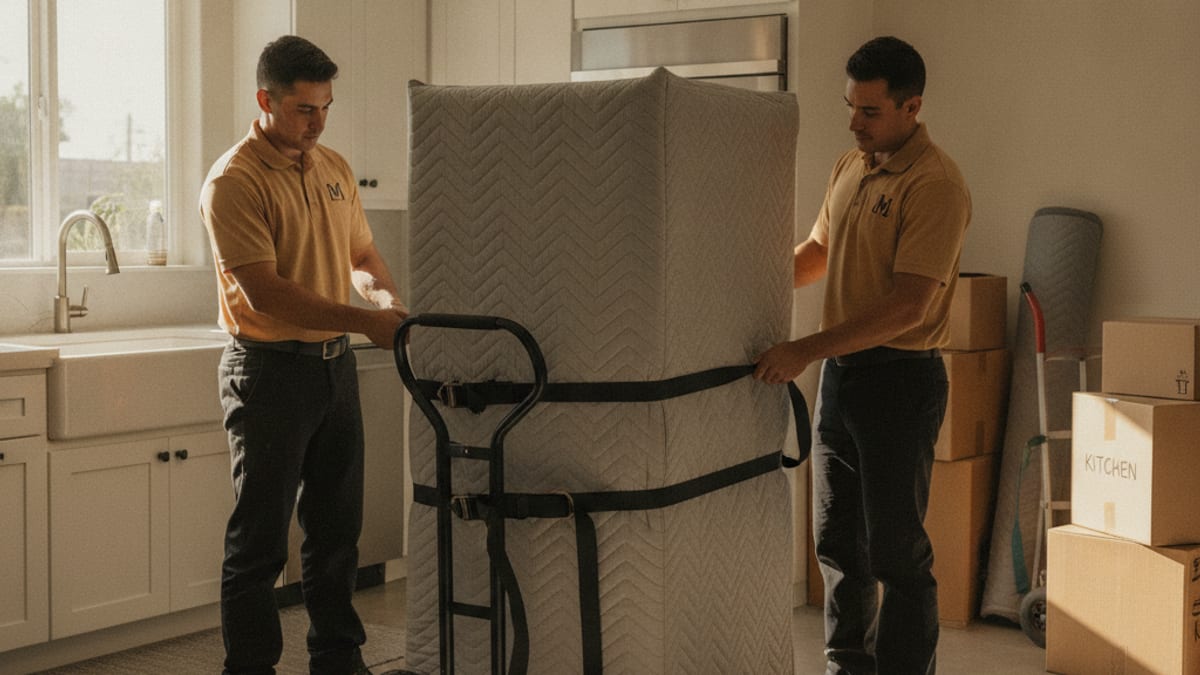
Appliances get handled differently than a dresser or a sofa, because a refrigerator’s compressor, a front-loader’s suspended drum, and a gas range’s shutoff valve each carry their own way of getting damaged or dangerous if they’re tipped, dragged, or unhooked wrong. The mover you book through Master Movers San Diego preps each appliance for the specific way it fails, using the right dolly, straps, and blanket padding instead of just muscle and a hand truck.
What do appliance movers do differently?
Appliance movers treat each machine as a mechanical object with a specific failure point, not a box that happens to be heavy. A refrigerator has a compressor and sealed cooling lines that need to stay upright and settle before they’re plugged back in. A front-load washer has a drum suspended on springs that can tear loose if the machine gets jostled without its transit bolts in. A gas range has a shutoff valve and a flexible connector that a mover isn’t licensed to touch.
The other difference is how appliances get carried. A dresser can go on a standard four-wheel dolly with straps and take a bump. A refrigerator or a stacked washer-dryer set needs an appliance dolly with a stair-climbing frame and a ratchet strap rated for its full weight, because these machines are top-heavy, boxy, and easy to tip through a doorway. A mover handling furniture moving also handles appliances, but the prep work and the equipment are built around each machine, not a generic heavy-item process.
How do you prep a refrigerator for moving?
A refrigerator needs to be emptied, defrosted for at least 24 hours, and secured before it comes off the wall. Start by emptying the fridge and freezer completely and tossing anything that won’t survive a few hours without power. Unplug it and prop the doors open, then let it defrost for a full 24 hours so no water pools inside the unit or leaks out during transport.
Once it’s dry, tape or zip-tie the doors shut, or remove them if the doorway or hallway is tight, and secure any loose shelves and drawers so they don’t slide and crack in transit. The water line and ice maker hose get disconnected and coiled up so nothing drags or snaps. A refrigerator has to travel upright the entire time, never on its side or back, because tilting it can send oil into the cooling lines and damage the compressor. Once it’s at the new place, it needs to sit for a few hours before it’s plugged back in, so the compressor oil can settle again.
How do you move a washer and dryer?
A washer and dryer both get disconnected from water, power, and any vent line before they’re moved, and a front-load washer needs its transit bolts reinstalled first. Front-loaders ship from the factory with bolts that lock the drum in place during transport, and those same bolts, or a mover-carried substitute, need to go back in before the machine gets tipped or carried, or the suspended drum can slam against the housing and wreck the bearings.
For a top-load washer, the water supply hoses get shut off and disconnected at the wall, then drained into a towel or bucket before the hoses get coiled and taped to the back of the machine. A gas dryer’s flexible gas connector and an electric dryer’s power cord both get disconnected the same way, but the dryer vent hose or duct connection also comes off first so it doesn’t rip loose mid-move. Both machines then go on an appliance dolly, strapped upright, with moving blankets wrapped around the corners and control panel to protect the finish and the electronics.
Do movers disconnect gas and water lines?
Movers disconnect standard water supply lines, like a washer’s hoses or a dishwasher’s water line, but a hardwired gas connection on a range or a dryer needs a licensed plumber or gas fitter, not the moving crew. A dishwasher’s water line and drain hose are straightforward shutoffs that a mover handles as part of the appliance prep, same as a washer’s hoses.
A gas range is different. It’s connected to a gas line with a shutoff valve, and disconnecting or reconnecting that line is plumbing and gas-fitting work that falls outside what a moving crew is licensed to do. If a gas range needs to move, plan to have a licensed plumber or gas fitter shut off and cap the line before moving day, and reconnect and test it at the new address. The moving crew handles getting the range itself onto the truck safely once the gas line is capped. Being upfront about this boundary is safer than pretending a mover can do a gas fitter’s job.
What drives the cost of moving appliances in San Diego?
Appliance work is priced on labor, not on a per-item sticker, so the number comes from how many machines are moving, how much disconnect and disassembly they need, and the access at both ends. Ask for it in the mover’s written estimate rather than guessing from a national average.
| What moves the number | Why it matters |
|---|---|
| How many large appliances are going | Each one is its own prep, dolly run, and reset |
| Disassembly, transit bolts, or a water-line disconnect | Adds crew time before anything leaves the room |
| Stairs, a long carry, or tight condo access | Top-heavy machines slow down the moment the path narrows |
| A gas range or gas dryer line | A licensed plumber or gas fitter bills separately, outside the moving quote |
Appliance costs usually get folded into a larger local moving job rather than billed on their own, so ask for an itemized estimate that breaks out the appliance labor. That way the disconnect, dolly work, and reassembly are visible line items instead of a surprise add-on at the end of the day. If you’re weighing what the rest of the move costs on top of appliances, the guide on what a local move costs in San Diego breaks down the full picture.
Are my appliances covered if they’re damaged?
Released value protection is the basic coverage that comes free with an interstate move, and federal rules set it at 60 cents per pound per article (49 CFR part 375). This is a federal FMCSA figure for interstate moves only; California intrastate moves fall under BHGS rules. It pays by weight, not by what the machine is worth, and that math works badly for appliances. A 250-pound refrigerator is covered for about $150 under interstate released value no matter what you paid for it. For a machine carrying a compressor, an inverter board, or a smart panel, that is a formality rather than protection.
Full value protection is the better call for any appliance with real replacement cost, especially a newer refrigerator or a smart washer and dryer set. Read the comparison of released value vs full value protection before signing the estimate so you know exactly what’s covered. Keep your own photos of each appliance before moving day, including the serial number plate, so there’s a clear record if a claim ever needs to be filed.
What should San Diego homeowners know about moving appliances locally?
San Diego’s mix of garage laundry setups, high-rise condos, and hillside driveways each change how appliances move locally. A lot of homes here keep the washer and dryer in the garage rather than an indoor laundry room, which usually makes access easier since the truck can park close and skip the stairs entirely.
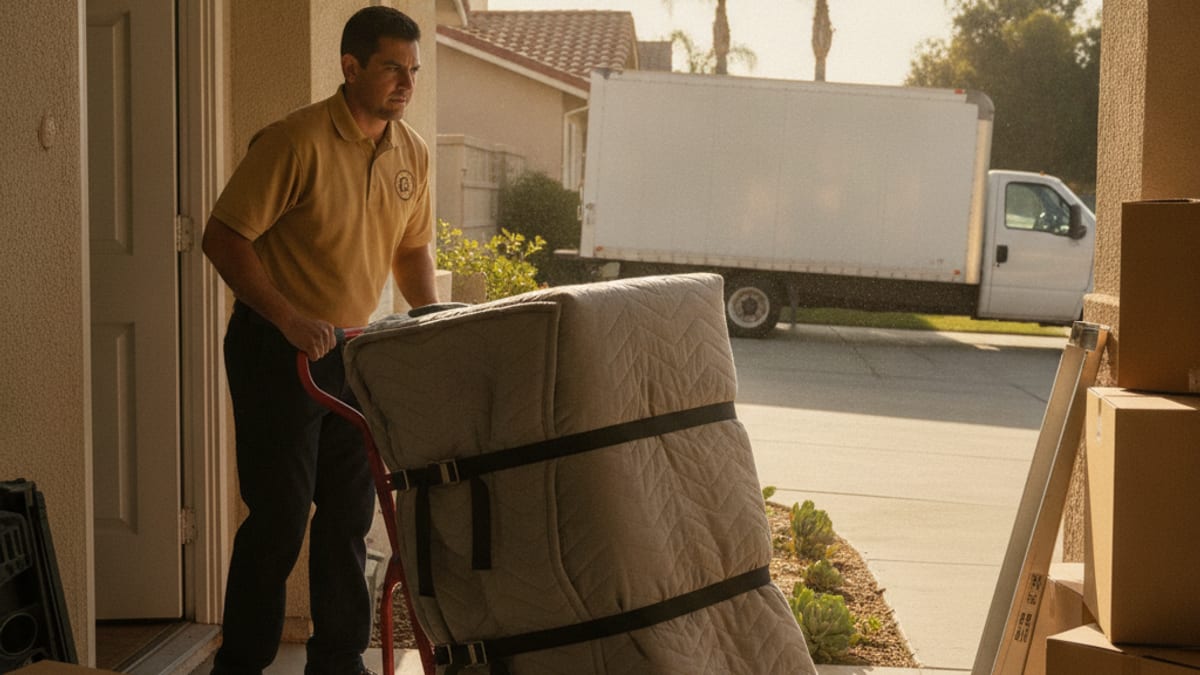
Downtown, Little Italy, and Mission Valley condos are the opposite case. A refrigerator or stacked washer-dryer coming down a narrow hallway or through a shared freight elevator needs the elevator reserved ahead of time and extra hands on hand, since appliance dollies don’t maneuver in tight condo hallways the way they do in a single-family home. Hillside driveways in La Jolla and Point Loma add their own wrinkle, since a steep grade changes how safely a loaded appliance dolly rolls down to the truck. Summer heat matters too. Appliance moves in inland areas like Escondido and Santee are best scheduled for morning slots, since a hot garage or driveway makes heavy dolly work slower and riskier by afternoon. Mention your setup, your floor, and any elevator rules when you call, so the mover plans the right equipment and timing.
What should I tell the crew when booking an appliance move?
Tell the crew exactly which appliances are moving, whether any are gas-connected, and what the access looks like at both addresses. Appliance movers need to know if it’s a fridge, washer, dryer, range, dishwasher, or freezer, whether the range or dryer runs on gas, and which floor each appliance starts and ends on, so they bring the right dolly and block enough time.
Confirm your refrigerator will be defrosted and empty before the crew arrives, and line up a licensed plumber or gas fitter in advance if a gas range or gas dryer needs disconnecting. Then call (858) 400-4069 to describe your appliances and get matched with a licensed mover who can write an estimate that accounts for the prep, the dolly work, and any stairs or long carries up front.
Frequently asked questions
How much does it cost to move appliances in San Diego?
It is billed as labor, not as a flat per-item fee, so it comes down to how many machines are moving, whether any need a disconnect or transit bolts, and what the stairs and carry look like at both ends. Call (858) 400-4069 to get matched with a licensed mover who can write an estimate based on your specific appliances.
How long before moving day should I defrost my refrigerator?
Defrost the refrigerator at least 24 hours before moving day, after it’s been emptied and unplugged with the doors propped open. That gives the interior time to dry completely so no water pools or leaks during transport, and it lets the compressor sit idle before it gets tipped or moved.
Do movers disconnect a gas stove or gas dryer?
No. Movers disconnect standard water lines like a dishwasher or washer hose, but a hardwired gas connection on a range or dryer needs a licensed plumber or gas fitter to shut off, cap, and later reconnect. The moving crew handles getting the appliance itself onto the truck once the gas line is capped.
Does a front-load washer need special prep before moving?
Yes. A front-load washer has a drum suspended on springs that needs to be locked in place with transit bolts before the machine is tipped or carried. Skipping this step risks the drum slamming against the housing and damaging the bearings during the move.
Is my refrigerator covered if it’s damaged during the move?
Not if you sign away the default. Released value protection costs nothing and pays 60 cents per pound per article under federal rules for interstate moves, so a 250-pound refrigerator is covered for roughly $150 on an interstate shipment however much it cost. It applies only when you sign for it in place of the full value protection those rules set as the default. Full value protection is the right call for a newer refrigerator or a smart washer and dryer set with real replacement cost. Both options have to appear on your written estimate.
Do you move other heavy items besides appliances?
Yes. The same licensed movers and equipment handle other heavy, awkward items. If you’re loading heavy pieces yourself, the guide on how to load a moving truck covers the right order and technique. Moving a home gym too, see the gym equipment movers guide, and if you’re not sure whether something can go on the truck at all, the list of what movers won’t move covers the items every San Diego mover turns down. For packing everything else in the kitchen and laundry room, packing services or labor-only moving crews can handle just the heavy lifting.