Moving gym equipment in San Diego adds labor on top of the standard move, and the amount depends on the weight, the disassembly, and the access at both ends. Gym equipment movers in San Diego treat these pieces differently than a couch, because a loaded weight rack, a treadmill motor, and a cable machine each fail in their own way if they’re tilted, dragged, or carried without being broken down first. Master Movers San Diego is a referral marketplace that can try to match you with a licensed mover who disassembles what needs to come apart, pads the electronics, and moves the heavy iron with straps and a dolly instead of muscle alone.
What do gym equipment movers do differently?
Gym equipment movers break the equipment down to its safe-carry weight, protect the moving parts, and match the lifting method to each piece. A treadmill isn’t a solid object. It’s a motor, a folding deck, and a control console, and each part handles stress differently. A squat rack looks simple until it’s loaded with 300 pounds of plates that have to come off before anything moves. The mistake most DIY moves make is treating a home gym like furniture and carrying it whole.
The other difference is weight distribution. A single Olympic barbell, a rack, and a set of bumper plates can add up to 600 pounds concentrated in one corner of a room. That much dead weight on a hand truck without straps is how floors get gouged, backs get hurt, and equipment gets dropped. The same kind of licensed mover listed on the furniture movers page can handle a home gym, but gym gear adds the twin problems of heavy iron and sensitive electronics in the same job.
How do movers move a treadmill or Peloton?
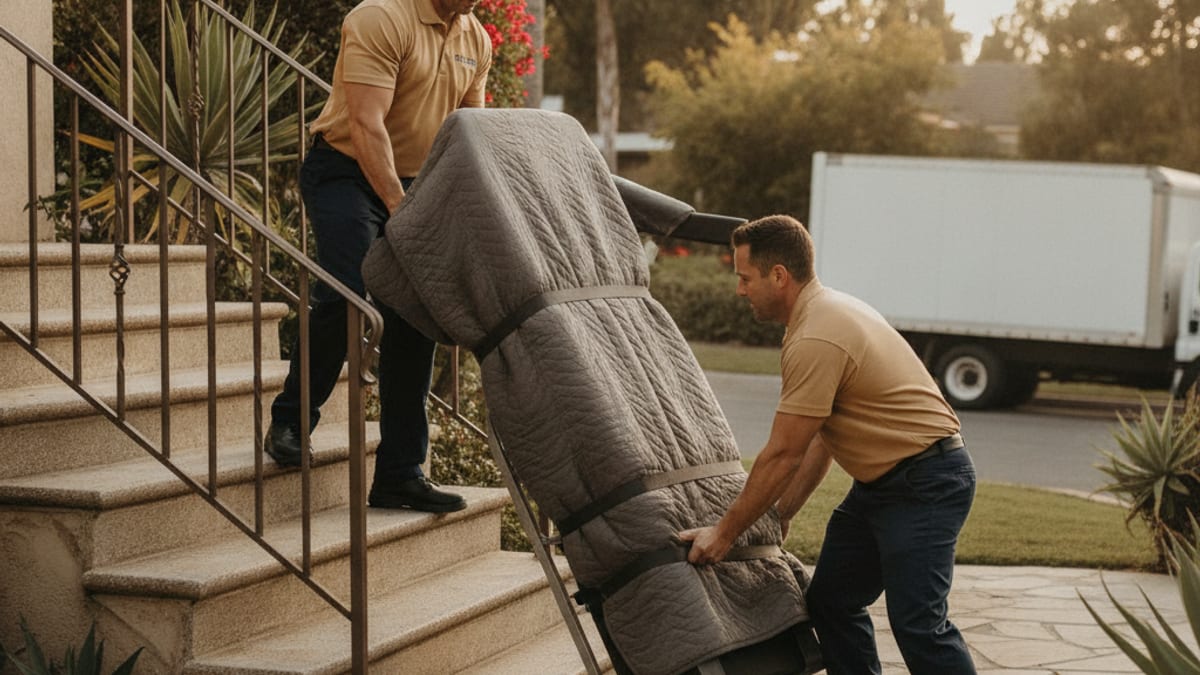
Movers fold or partly disassemble the machine, lock or brace the moving parts, wrap it in moving blankets, and carry it upright on a dolly. A treadmill deck folds up and locks on most models, which shortens it enough to clear doorways and turns. The console and any loose cables get padded so nothing snaps off in transit. A Peloton bike comes apart at the seat, handlebars, and sometimes the screen, which drops both the weight and the risk of a cracked display.
The reason this matters is that treadmill and Peloton screens and motors are the expensive part, and they’re the first thing to break when a machine gets carried flat or set down hard. Folding, bracing, and wrapping is the same disassembly logic movers use for beds, sectionals, and other break-down furniture. If your machine came with the original assembly manual, set it aside for the crew. The reassembly goes faster when the bolt pattern is documented, especially on a rower or a cable machine with a specific cable route.
How do you move heavy weights and a squat rack safely?
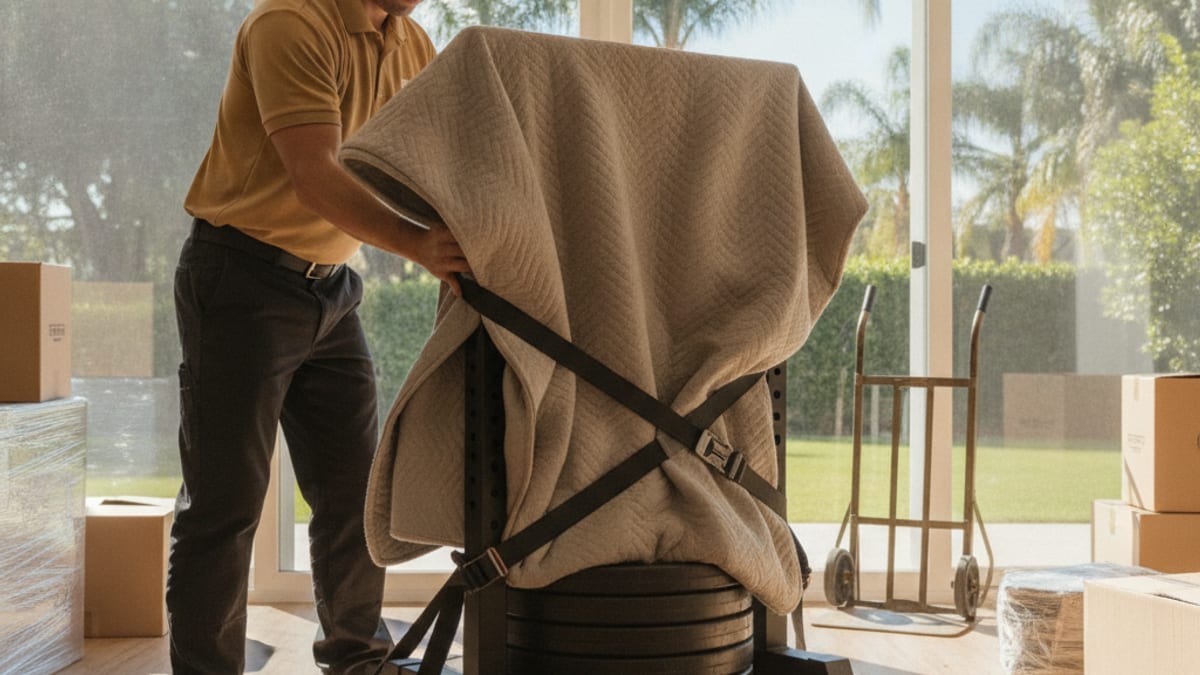
You strip the rack down to an empty frame first, move the plates separately in small loads, and never carry a loaded rack. This is the single most important rule with a home gym. Bumper and iron plates get moved a few at a time, either boxed or stacked low on a dolly, because a tall stack of plates is top-heavy and slides. The empty rack frame then comes apart at the uprights and crossmembers, or gets carried as a frame by two movers with straps if it doesn’t break down.
Dumbbells, kettlebells, and a bench are straightforward but heavy, so they go in small, sturdy boxes rather than one giant tote that no one can lift. A cable machine or a Smith machine is the exception that usually needs real disassembly, because the pulleys, cables, and weight stack are both heavy and easy to misalign. Tell the crew ahead of time if you have one, so they plan the right number of hands and the right amount of time. When a job is mostly loading heavy iron you’ve already broken down, labor-only movers matched through this marketplace can handle just the muscle while you keep the truck and the driving.
What does it cost to move gym equipment in San Diego?
Cost depends on the weight, the disassembly, and the access. A single heavy piece such as a treadmill or Peloton falls into the same category as a single furniture piece, where the market range in San Diego is roughly $150 to $450 depending on stairs and access. A full home gym with a rack, weight plates, a cardio machine, and a cable machine adds scope and time to the mover’s estimate, because each piece needs its own breakdown and padding.
What moves the number:
- Disassembly: a folding treadmill costs less to move than a bolted-together cable or Smith machine that needs full teardown and rebuild.
- Stairs and access: garage-to-truck on a flat driveway is straightforward; a second-floor condo or a hillside driveway in La Jolla or Clairemont adds carry time.
- Total weight: a full rack with plates and a bench concentrates hundreds of pounds in one spot, which means more hands and a stair-climbing dolly.
Most of these costs get folded into a larger job handled by local movers rather than billed on their own, so ask for a written estimate that itemizes the gym equipment separately. That way you can see exactly what the disassembly and heavy-lift labor add, instead of finding it as a surprise on moving day. A rough rule of thumb: the more the mover has to take apart and put back together, the more the labor climbs, which is why a bolted-together cable machine costs more to move than three treadmills that fold.
Is my gym equipment covered if it’s damaged during the move?
On interstate moves regulated by FMCSA, full value protection is the default, and released value protection covers items at $0.60 per pound per item only when you sign for it instead. A 250-pound treadmill valued at $2,500 would pay out $150 under released value if it’s destroyed. For a piece with a screen and a motor, that’s a formality, not real coverage. Electronics and cardio machines are exactly the kind of item where released value falls short. California intrastate moves fall under BHGS rules; ask the mover you book what valuation applies to your specific move.
Full value protection is worth asking about for a home gym with any real money in it, especially connected machines like a Peloton, a Tonal, or a high-end treadmill. Read the breakdown of released value vs full value protection before signing the estimate, so the coverage terms are clear. It’s also worth keeping photos of each machine before the move, including the screen powered on, so there’s a personal record of its condition if a claim ever needs to be filed.
What should San Diego homeowners know about moving a home gym locally?
San Diego home gyms live in two places that each add a wrinkle: the garage and the spare bedroom, often up a flight of stairs. Garage gyms are the most common setup here, and the good news is the truck can usually back close to the door. The catch is the driveway grade on hillside properties in La Jolla, Point Loma, and Clairemont, where a steep slope changes how the crew rolls heavy plates and a loaded dolly down to the truck.
Second-floor and condo gyms bring the harder problem. A rack and a stack of plates coming down a narrow staircase or through a shared elevator needs planning, extra hands, and sometimes a specific time window in a building with elevator rules. If the equipment is in a downtown, Little Italy, or Mission Valley high-rise, reserve the freight elevator when booking the move. Summer heat is the last factor people forget. Garage and outdoor-adjacent gym moves get scheduled for morning slots when the temperature is manageable, because hauling iron in a 100-degree inland garage in Escondido or Santee is slower and riskier in the afternoon. Mention the setup, the floor, and the access when calling, so the mover sizes the job correctly.
What to tell the mover when booking a gym equipment move
Have a list of the actual machines and roughly what each one weighs ready, not just “a home gym.” Gym equipment movers need to know the pieces (treadmill, Peloton, rack, cable machine), the total plate weight, whether anything is bolted to a wall or floor, and which floor it’s all on. That detail is what lets the mover decide how many people to send, how much time to block, and whether to bring extra straps and dollies for the heavy iron.
Note anything already loose, wobbly, or missing hardware, so there’s a record before the move starts. Then call (858) 400-4069 to describe the equipment and get matched with a licensed mover who puts a written estimate together that accounts for the disassembly and heavy lifting up front, rather than a surprise add-on the morning of the move.
Frequently asked questions
How much does it cost to move gym equipment in San Diego?
A single treadmill or Peloton falls into the same category as a single heavy furniture piece, where the San Diego market range is roughly $150 to $450 depending on stairs and access. A full home gym adds scope and time on top of that. The exact number depends on how much has to be disassembled, the total weight, and the access at both ends. Call (858) 400-4069 for a written estimate based on the specific equipment.
Do movers disassemble treadmills and Peloton bikes?
Yes. A licensed mover folds and braces a treadmill’s deck and console, and breaks a Peloton down at the seat, handlebars, and often the screen. That drops both the weight and the risk of a cracked display or a snapped cable, then the mover reassembles it at the new place.
Can movers move a full weight set and squat rack?
Yes, but the rack gets stripped to an empty frame first and the plates move separately in small loads. A loaded rack is never carried as one piece. Dumbbells, kettlebells, and a bench go in small sturdy boxes so each load stays liftable.
Is a treadmill covered by valuation during a move?
Not fully under the default federal coverage for interstate moves. Released value protection pays $0.60 per pound per item on interstate moves, so a 250-pound treadmill worth $2,500 would net about $150 if it’s destroyed. Full value protection is worth asking about for machines with screens and motors. California intrastate moves fall under BHGS; ask the mover what applies.
Do I need to prep my gym equipment before moving day?
Some light prep helps. Set aside the assembly manuals, note anything already loose or missing hardware, and keep photos of each machine, including screens powered on. The mover handles the actual disassembly and wrapping, but documented bolt patterns and condition records make both the move and any future claim go smoother.
Do movers handle other heavy specialty items besides gym equipment?
Yes. The same kind of licensed mover handles other heavy and specialty pieces. For a piano, read the guide on how to move a piano without damaging it or your floors, which connects to the piano and gun safe movers page. For a slate pool table, see the pool table movers guide. And for items that may not go on the truck at all, the list of what movers won’t move covers the pieces every San Diego mover turns down.