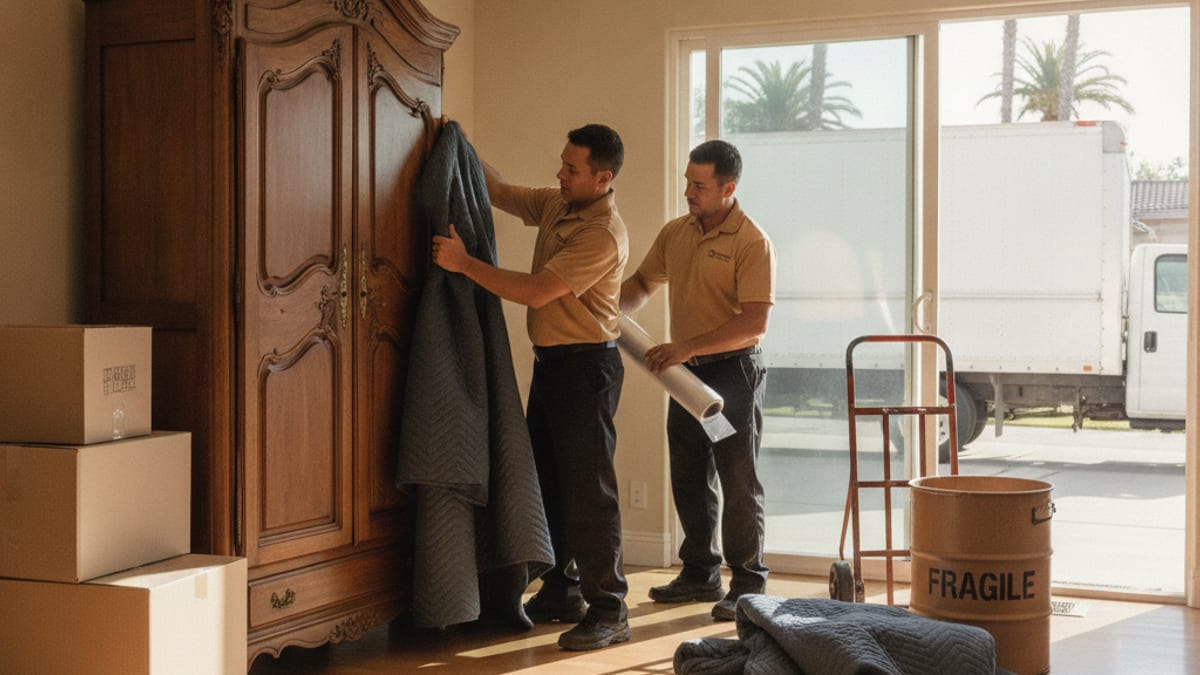
Antique and fine-furniture moving in San Diego typically runs $150-$450 per piece for custom crating on top of the standard move, and a room with multiple antiques adds up based on how many pieces need crating versus blanket-wrap. Licensed antique furniture movers in San Diego treat these pieces differently than a dresser from a big-box store. Hand-built crates, museum-grade blanket-wrap, and a crew trained to read old joinery before they pick anything up. A 150-year-old highboy with hand-cut dovetails can’t be replaced if it’s damaged, and that changes how the whole move gets planned.
What do antique furniture movers do differently?
Antique furniture movers slow down, inspect the piece first, and choose protection based on construction, not just size. A modern dresser is built with screws, particleboard, and modern glue that flexes under stress. A 19th-century sideboard is built with hide glue, hand-cut mortise-and-tenon joints, and thin veneer laid over solid wood. Those joints were never designed to handle being tilted, dragged, or set down hard, and decades of expansion and contraction have often already weakened them.
Fragility isn’t the only issue. Value and irreplaceability change the calculus too. A scratched modern coffee table is an inconvenience. A cracked antique tabletop with an inlay pattern that took a craftsman weeks to complete is a loss with no repair path that restores the original value. The same principle that applies to any large, heavy piece, covered by the furniture movers you book, applies here, but antiques add a layer of irreplaceability that a modern piece simply doesn’t carry.
What’s the difference between blanket-wrap and custom crating?
Blanket-wrap means the piece is padded in moving blankets, shrink-wrapped, and carried as-is. Custom crating means the piece goes inside a built plywood box lined with foam, sealed shut, and moved as a sealed unit. Both are legitimate ways to move an antique, and the right one depends on the piece.
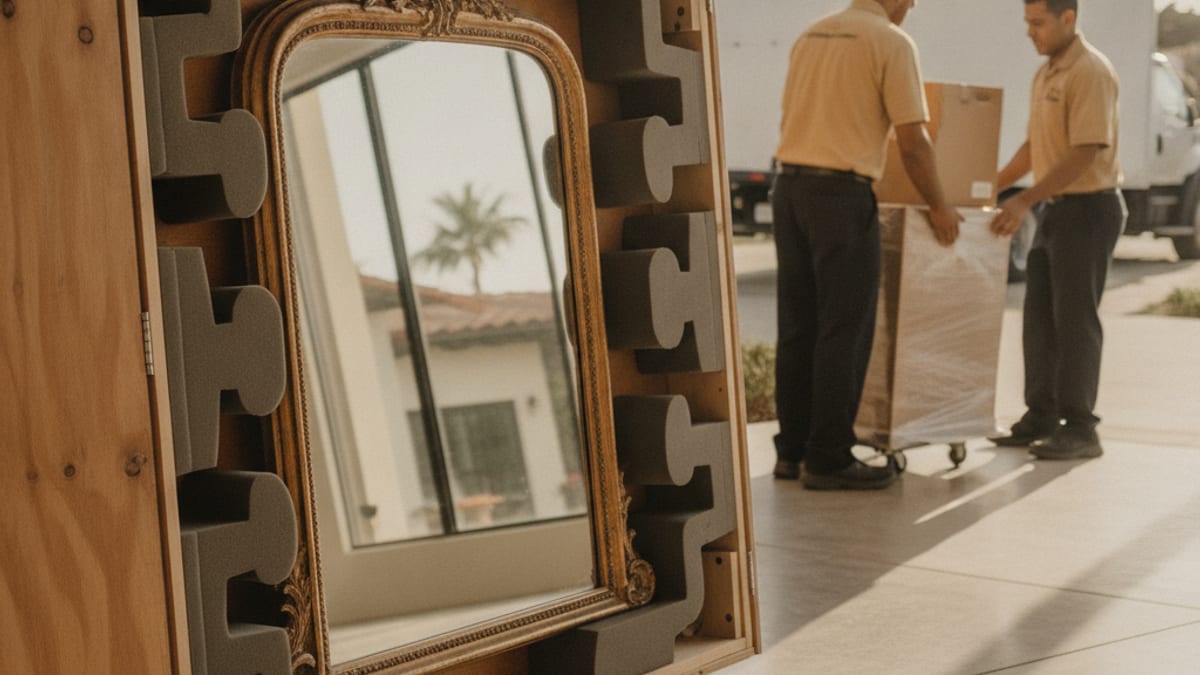
Blanket-wrap works for solid, structurally sound furniture making a short trip within the same move: a sturdy oak dresser, a dining table with no glass or marble, a chest with tight joints. Custom crating is the better call for glass-front cabinets, marble or stone tabletops, mirrors, gilded frames, veneer surfaces with any lifting or loose sections, and anything headed into long-term storage or a long-distance haul. If a piece would be catastrophic to lose, it gets a crate.
How does custom crating work, and how far ahead do I need to book it?
Custom crating means the mover measures the piece, builds a plywood crate to its exact dimensions, foam-lines the interior, and seals it before moving day, and that process typically takes 1 to 2 days of lead time. The crate isn’t a generic box pulled off a shelf. It’s built around the specific piece, corner by corner, so nothing shifts in transit.
This is the same crating process the San Diego piano and gun safe movers you book use for pianos, art, and other irreplaceable pieces. The mover measures the item, sources plywood and foam cut to size, and assembles the crate on site or in the shop depending on the piece. Because it takes real build time, custom crating isn’t something to request the morning of your move. Call ahead as soon as you know a piece needs one.
What drives the cost of moving antique furniture in San Diego?
Several factors stack on top of each other. Here’s how they typically break down.
| Scenario | What drives the cost |
|---|---|
| Blanket-wrap only, single piece, ground floor | Included in standard move |
| Custom crate, single piece, average size | Lower end of the $150-$450 per-piece crating band |
| Custom crate, large or complex piece (armoire, china cabinet) | Upper end of the $150-$450 per-piece crating band |
| Full room of antiques, mixed crating and blanket-wrap | Multiple pieces at $150-$450 each, depends on how many need crates |
| Stairs, hillside access, or a long carry from truck to door | Adds time and crew; ask the mover what access adds to the estimate |
| Long-distance move requiring crating for transit | Crating scope adds to the long-distance estimate per piece |
Most of these costs get folded into a larger job handled by local movers rather than billed as a stand-alone line item, so ask the licensed mover you book for a binding estimate that itemizes the crating separately from the rest of the move. That way you know exactly what you’re paying for each piece.
Is antique furniture covered by insurance during a move?
On an interstate move, federal FMCSA rules make full value protection the default, and released value protection at $0.60 per pound per item applies only if you sign the released value statement on the bill of lading. That $0.60 pays out regardless of what the item is actually worth. A 40-pound antique side table valued at $3,000 would net a payout of $24 if it’s destroyed in transit. That’s not real coverage, it’s a formality required by federal law for moves that cross state lines. California intrastate moves fall under BHGS rules, and the valuation terms are set by the mover’s written estimate.
Antiques call for full value protection at minimum on interstate moves, and any piece with real appraised value should carry a separate rider or a standalone policy through a specialty fine-art and antiques insurer. Read the full breakdown of released value vs full value protection before you sign anything, so you know exactly what you’re agreeing to on moving day.
What should San Diego homeowners know about moving antiques locally?
San Diego’s older neighborhoods add their own wrinkles that national moving guides skip. Craftsman bungalows in North Park, Kensington, and Mission Hills were built with narrow doorways and tight staircases that predate modern furniture sizing. A nine-foot armoire that fit through the home’s original opening may need to go out a window or have a door pulled from its hinges today.
Hillside properties in La Jolla and Point Loma bring their own access problems: steep driveways, multiple flights of exterior stairs, and narrow street parking that limits how close the truck can get. That changes crew size and adds time to the job, so mention it when you call for a quote.
Coastal humidity swings, damp in winter and dry during Santa Ana season, cause wood to expand and contract over the years. That’s part of why loose veneer and weakened glue joints tend to show up on move day, right when a piece gets tilted or carried for the first time in a decade. Antiques also show up heavily in estate settlements and downsizing moves, where heirlooms need to go to a new home, into storage, or to family members in different cities in the same trip. If that’s your situation, the senior downsizing move checklist for San Diego County walks through the broader timeline alongside the antique-specific handling covered here.
What should I tell the mover when booking an antique move?
Give the mover exact details on each piece, not just a room count or a general description. Antique furniture movers need the dimensions, the material (solid wood, veneer, marble, glass), any existing damage or prior repairs, and whether the piece has a written appraisal. That information is what lets the mover decide whether blanket-wrap is enough or a custom crate needs to be built before moving day.
Take a few photos of each piece and note anything already loose or cracked, so there’s a clear record before the move starts. Call (858) 400-4069 to connect with a licensed mover who can describe your pieces and provide a binding estimate that accounts for the crating up front, rather than a surprise add-on the morning of the move.
Frequently asked questions
How much does it cost to move antique furniture in San Diego?
Custom crating for a single piece typically runs $150-$450. A room with multiple antiques adds up per piece, and the total depends on size, material, and how much crating versus blanket-wrap each one needs. Call (858) 400-4069 to connect with a licensed mover who provides a binding estimate based on your specific pieces.
Do movers crate antiques?
Yes. Movers crate antiques when a piece has glass, marble, mirrors, gilding, or fragile veneer, or when it’s headed into storage or a long-distance haul. Sturdier pieces making a short local trip are often fine with blanket-wrap alone. The mover makes that call after inspecting the piece.
Is antique moving covered by insurance?
Not if you sign away the default. On interstate moves, released value protection pays $0.60 per pound per item, which comes nowhere close to an antique’s real value, and it applies only when you sign for it in place of the full value protection federal rules set as the default. Full value protection on interstate moves, or a separate rider through a fine-art and antiques insurer, is the right call for anything with real appraised worth. Ask the mover you book what valuation terms apply to California intrastate moves.
What happens if a piece is extremely valuable or one of a kind?
Get a written appraisal before the move and tell the crew about it when you book. Extremely valuable or irreplaceable pieces usually get custom crating regardless of how sturdy they look, and they’re a good candidate for a standalone insurance policy rather than relying on the mover’s default coverage.
Can antique movers handle a hillside home in La Jolla or Point Loma?
Yes, but it takes planning. Steep driveways, exterior stairs, and tight street parking common to hillside San Diego neighborhoods change the crew size and the time the job takes. Mention your address and access details when you call so the mover can plan the route and staffing correctly.
Do movers handle other specialty items besides antiques?
Yes. The same licensed movers handle other specialty pieces too. If you’re also moving a piano, read the guide on how to move a piano without damaging it or your floors. Same story for a slate pool table: see the pool table movers guide. And if you’re not sure whether something in your home can go on the truck at all, the list of what movers won’t move covers the items every San Diego mover turns down.