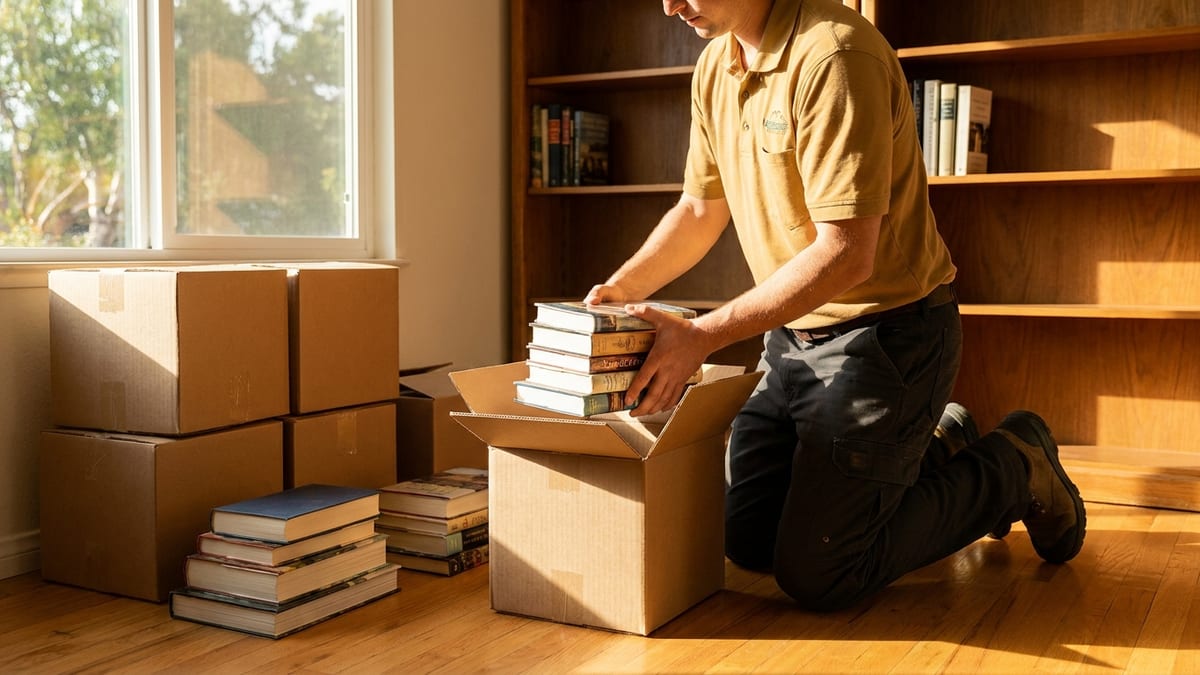
To pack books for a move, use small boxes, keep each under about 30 to 40 pounds, and pack heavy hardcovers flat in stacks. Stand paperbacks upright like on a shelf, fill gaps with packing paper, and never overfill a box you can’t lift with one hand. Books are some of the heaviest things in any home, and a single large box of them can blow out its own bottom before it leaves the floor.
What is a small book box, and how many books fit in one?
A small book box measures 16 x 12 x 12 inches and holds about 1.5 cubic feet, which is roughly 25 to 30 average hardcovers or 40 to 50 paperbacks. Packed full of hardcovers it lands around 35 to 40 pounds, which is the heaviest a box should be if a person has to carry it repeatedly.
That is the entire reason the size exists. It is not a small box because books are small. It is a small box because books are dense, and the box is sized so that a full one is still liftable.
Suppliers sell the same carton under three names, so do not get thrown by the labelling. “Small box”, “book box” and “1.5 cu ft box” are the same thing. If a store only lists cubic feet, 1.5 is the number you want.
Why you should only use small boxes for books
Books are deceptively heavy. A standard large moving box filled with paperbacks can top 60 or 70 pounds. That’s not a lifting problem, it’s a structural one.
Most moving boxes are rated for a reason. Overfill a medium or large box with hardcovers and the cardboard itself will give out at the bottom seam, often while someone is carrying it up or down stairs. The contents spill, spines crack, and if anything was fragile nearby, it breaks too.
The rule is simple: book boxes should be small boxes. A standard 1.5 cubic foot box is ideal. You can stack it full and still keep the weight manageable. If you only have larger boxes, fill the bottom third with books and top off the rest with lighter items like linens or pillows.
For more on picking the right containers for every room, see the best moving boxes guide.
The three methods for packing books (and when to use each)
Not all books are the same shape or size, and how you orient them in the box matters more than most people expect.
| Book type | Best method | Note |
|---|---|---|
| Hardcovers, large format | Flat, stacked face-up | Distribute weight evenly, alternate spine direction |
| Standard paperbacks | Upright, spine down | Pack like a bookshelf row, snug but not crammed |
| Tall or oversized paperbacks | Flat on top of a hardcover layer | Prevents warped covers from pressure |
| Thin paperbacks and magazines | Flat stacks, small bundles | Tie loosely with twine before boxing |
| Coffee table books | Flat, one or two per layer | Heavy, protect with paper between each |
Flat stacking is the most stable method for hardcovers. Lay them cover-side up in rows, alternating which direction the spine faces to distribute pressure evenly. Keep stacks to three or four books before adding a layer of packing paper.
Spine-down upright is the right method for paperbacks. Think of it as packing a shelf into a box. Books stand on their spines in a tight row with a little give, not crammed so tight the pages bow inward. Fill any gaps at the ends with crumpled packing paper so nothing shifts in transit.
Never pack books spine-up. It looks tidy but it stresses the binding, especially on older paperbacks and anything with a glued spine. After a bumpy ride across San Diego, you’ll open the box to find pages fanning loose.
For a full room-by-room approach to packing everything else in the house, check out how to pack for a move room by room.
Protecting valuable, rare, or leather-bound books
If you have anything collectible, signed, or genuinely irreplaceable, treat it differently from the rest of your library.
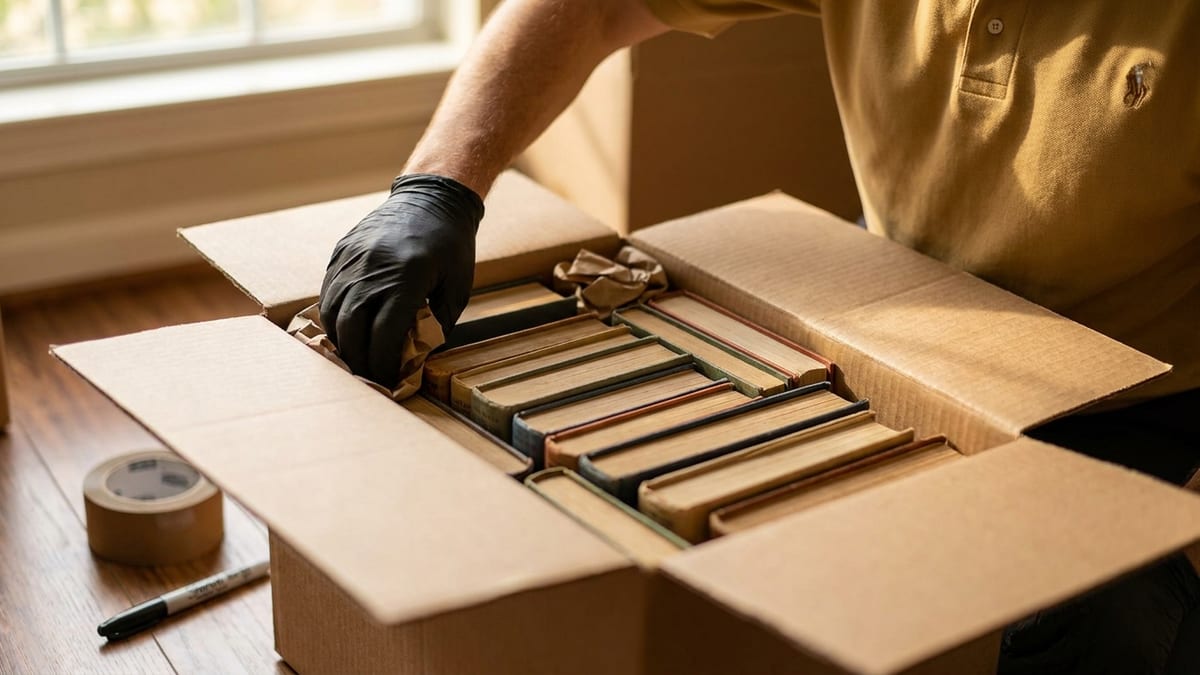
Wrap each book individually in acid-free tissue paper or unprinted newsprint before it goes in the box. Printed newspaper ink can transfer to covers, especially on older books with lighter-colored bindings. Plastic wrap is fine for a single layer of protection, but don’t wrap leather tightly in plastic for long periods because leather needs to breathe or it can dry out and crack.
For leather-bound books, some collectors apply a thin coat of leather conditioner before wrapping to guard against dry conditions during transit. This is optional and depends on the book’s condition and the move’s timing.
Pack valuable books in a dedicated small box with extra padding on all six sides. Label that box clearly and keep it with items you’re moving yourself if possible, rather than putting it in the truck.
Taping and labeling book boxes correctly
Book boxes need more tape than most. Use two strips of packing tape across the bottom seam, then two more running perpendicular. That cross pattern keeps the bottom reinforced even when the box flexes under weight.
On the top, the same cross pattern works. Don’t rely on a single strip of tape down the center seam. It holds fine for lighter boxes, but book boxes shift and press differently.
For labels, write “BOOKS” large on at least two sides. Add the destination room if you know it, but more importantly, add “HEAVY” so whoever picks it up knows before they commit their back to the lift. A color-coded sticker system helps too, especially if you have a lot of boxes moving at once.
If you’d rather not deal with the taping, wrapping, and labeling yourself, the licensed movers this marketplace can connect you with offer packing services that cover this kind of prep work before the truck arrives.
San Diego specifics: humidity, heat, and where not to store book boxes
San Diego has mild weather overall, but coastal humidity is real, and it affects books more than most people realize.
Coastal humidity and pests like silverfish can affect books if boxes sit in a garage for extended periods before a move. Keep book boxes indoors, off the ground, and away from moisture sources when possible.
Heat is another consideration. Prolonged high temperatures can make paper brittle and loosen glued spines. If there is a gap between move-out and move-in, storing book boxes in a climate-controlled space or an air-conditioned room helps preserve them.
For fragile items beyond books, the same careful approach applies. The guide to packing fragile kitchen items walks through methods that licensed movers commonly use.
If you’ve got a wall of bookshelves and the idea of packing all of it sounds exhausting, that’s a fair read of the situation. Call (858) 400-4069 and this marketplace can try to match you with a licensed mover who offers packing help for your move.
Frequently asked questions
What size box is best for packing books?
A small box, around 1.5 cubic feet, is the right size for books. Keep each box under 30 to 40 pounds. Larger boxes filled with books almost always exceed a safe lifting weight and can fail at the seams before they reach the truck.
Can I mix books with other items in the same box?
Yes, but only if the other items are light. Fill the bottom of a small box with books, then top it off with pillows, linens, or folded clothes. Never mix books with anything fragile, because book weight shifts during transit.
Should I pack hardcovers and paperbacks separately?
It helps, but it’s not required. The more important separation is by size and weight. Large hardcovers packed flat at the bottom of a box, with paperbacks standing upright above them, is a stable and efficient arrangement.
How do I keep books from getting damaged during a move?
Use small boxes, pack them snugly so books can’t slide around, and reinforce all seams with multiple strips of tape. Wrap anything valuable in acid-free tissue paper before boxing. Avoid leaving boxes in hot or humid spaces before and after the move.
Is it okay to pack books in garbage bags or laundry baskets?
Garbage bags offer no structural support and no protection against moisture. Laundry baskets work in a pinch for lightweight paperbacks over very short distances. For any real move, cardboard boxes with proper tape are the only reliable option. Books shift and compress in soft-sided containers and arrive with bent covers and cracked spines.
What’s the best way to label book boxes?
Write “BOOKS” and “HEAVY” on at least two sides of every box. Include the destination room on the top flap. If you’re using a color-coding system, add the sticker before you close the box, not after it’s stacked somewhere hard to reach.