Last updated: July 6, 2026
TL;DR
- Verify the California household mover license before you book. Since 2018, California household movers answer to the Bureau of Household Goods and Services, not the CPUC, and BHGS has a free online lookup at search.dca.ca.gov/hhm_search.
- A real estimate comes from an in-home or video walkthrough. A price quoted cold over the phone is a guess, and guesses grow on move day.
- Little to no deposit is normal for a local San Diego move. A big upfront cash demand is the single clearest red flag.
- Released Value (60 cents per pound per item on interstate moves by federal rule) and Full Value Protection pay out differently if something breaks. Know which one you’re signing before move day, not after.
- Movers are worth it for most 2 to 4 bedroom moves once you count your own time, your back, and the truck rental fees you’d pay anyway.
Choosing a San Diego mover comes down to five checks you can run in one phone call. Ask for the California household mover license number and verify it yourself at search.dca.ca.gov/hhm_search. Get a written estimate from someone who actually looked at your stuff, not a number guessed over the phone. Ask what the deposit is and why. Understand what your coverage pays if something breaks. Read the one- and two-star reviews before you read the five-star ones. Skip any of those and you’re trusting a stranger with your grandmother’s dresser and a few thousand dollars.
This guide walks through each check in plain terms, including the licensing detail most national moving-scam articles get wrong: California’s household movers haven’t answered to the CPUC since 2018. The checklist below works no matter which company you call. When you’re ready, Master Movers San Diego can try to match you with a licensed mover.
What license does a legit San Diego mover actually carry?
Every company that moves household goods inside California needs a California household mover license from the Bureau of Household Goods and Services (BHGS). That part, most articles get right. Where they fall behind is the agency that issues and enforces it. Until mid-2018, the California Public Utilities Commission (CPUC) handled household movers directly. Senate Bill 19 moved that authority to BHGS, a division of the California Department of Consumer Affairs, effective July 1, 2018. You’ll still hear people call it a “PUC number” out of habit, but the agency that actually checks the license today is BHGS.
Verifying it takes about two minutes. Ask the mover for their license number, then search it at search.dca.ca.gov/hhm_search. A real result shows an active status, current insurance on file, and a business name that matches the estimate sitting in front of you. If the name on the license doesn’t match the name on your paperwork, stop. That mismatch is how a licensed company’s number ends up on an unlicensed broker’s website.
One more distinction that trips people up: the California household mover license covers moves that start and end inside California. If you’re headed to Arizona or Nevada, the relevant number is a USDOT number filed with the federal FMCSA, not a state license. Ask which one applies to your move before you assume either one covers you.
Master Movers San Diego does not carry a household mover license, and should not: it is a referral marketplace, it performs no moves, and a license belongs to the company whose truck shows up. The mover you book holds theirs and will give you the number the moment you ask, so you can run this exact check before you sign anything. If anyone matching you with a mover claims the license is theirs, that is the mismatch described above.
How do rogue movers actually scam people?
The scams that show up in California complaint files follow a small set of patterns, and once you know them, they’re easy to spot.
The hostage load is the worst one. A crew quotes a low price over the phone, loads your entire home onto the truck, then announces a much higher number before they’ll unload anything. At that point you have almost no negotiating room, which is exactly why the scam works. The defense is upstream: never accept a firm price from a company that hasn’t seen your home, in person or on video. A binding estimate locks the number after a real walkthrough. A phone quote with no questions about your stairs, your furniture, or your street is not a price. It’s bait.
Other patterns to watch for: a company that only accepts cash or a wire transfer, a business name that changed in the last year with no explanation, a mailing address that turns out to be a UPS box, and a contract with blank fields you’re told to “just sign, we’ll fill it in later.” Every one of these is a way to make the paper trail disappear if something goes wrong.
Is a moving deposit normal, or a red flag?
For a local move inside San Diego County, the honest answer is little to none. Most legitimate California movers bill after the work is done, the way a plumber or an electrician would. A modest deposit can be reasonable for a long-distance move that requires booking a truck and crew weeks out, but it should be a specific, itemized amount, paid by card, with a receipt.
The red flag version looks different: a large percentage of the total demanded upfront, in cash only, before a written estimate exists. That combination shows up again and again in BHGS and BBB complaint histories. If a company won’t put your job on the calendar without cash in hand first, that’s your answer about whether to book them.
What does your coverage actually pay if something breaks?
For interstate moves, every mover is required to offer at least Released Value coverage, which pays $0.60 per pound per item regardless of what it actually cost (a 40-pound TV that gets crushed nets you $24). That’s the free, default federal option, and it’s rarely enough for anything you’d actually miss. Full Value Protection costs more but pays to repair or replace the item at current value, which is the coverage most people actually want for furniture, electronics, or anything with real value. California intrastate moves fall under BHGS rules, and the valuation figures may differ; ask the mover what applies to your specific move. The numbers and how to pick between them are covered in Released Value vs Full Value Protection. Read it before move day, not after something’s already broken.
Are professional movers worth it in San Diego?
For a studio or one-bedroom apartment, a rental truck and a couple of friends can genuinely be the cheaper call. Past that, the math shifts fast. A 2 to 4 bedroom home means heavy furniture, stairs, a truck you have to drive and park, and a full day of lifting that puts your back at real risk. Add up a rental truck, gas, insurance, pizza and beer for your friends, and a full day of two people’s time, and you’re often within a few hundred dollars of what a two-mover crew costs to do the same job in half the time, without anyone throwing out their back on your staircase.
We break down real 2026 price ranges by home size in how much a local move costs in San Diego. Run your own numbers against that table before you decide DIY is actually cheaper. Often it isn’t once your time and your back are counted honestly.
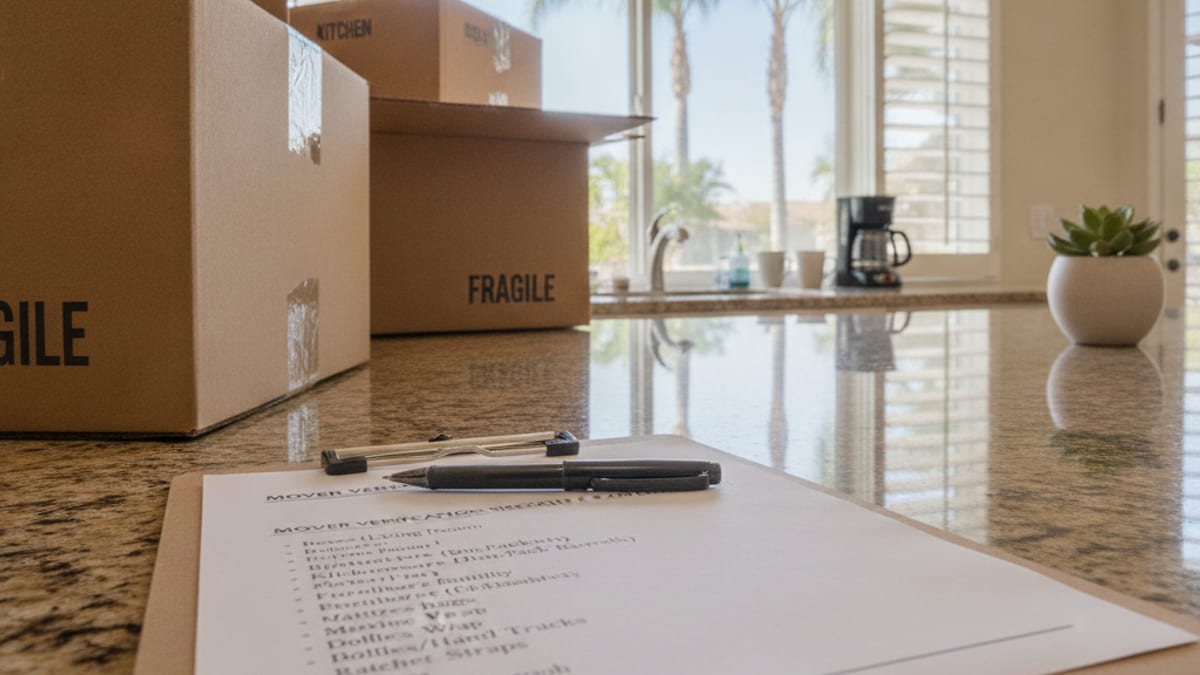
Your San Diego mover verification checklist
Run every company on your shortlist through this before you book:
- Ask for the California household mover license number and look it up yourself at search.dca.ca.gov/hhm_search.
- Confirm the business name on the license matches the name on your estimate exactly.
- Get a written, binding estimate after an in-home or video walkthrough, never a firm price over the phone alone.
- Ask what the deposit is, why, and whether it’s refundable. Walk away from a large cash-only demand.
- Ask whether coverage is Released Value or Full Value Protection, and get the difference in writing.
- Read the one- and two-star reviews on Google, Yelp, and the BBB before the five-star ones.
- Confirm the company has a real California street address, not just a phone number and a website.
- Ask how the crew handles your specific building: HOA insurance certificates, elevator rules, or permit parking.
- Get at least three written quotes before you book anyone.
If you’d rather start from a shortlist of licensed names instead of building your own from scratch, the guide to the best moving companies in San Diego walks through how to rank a shortlist using this same framework.
How do you spot fake mover reviews?
Star averages lie more often than the reviews themselves. A profile with hundreds of five-star reviews and zero criticism over several years usually means reviews are being filtered or purchased, not that the company is flawless. Real movers, even good ones, have a handful of rough days on record.
Look for the specific tells: reviews posted in tight clusters within days of each other, similar phrasing repeated across different names, and praise that’s generic (“great team, highly recommend”) with no mention of an actual address, date, or detail from the move. Genuine reviews tend to mention a neighborhood, a specific item, or a crew member’s name. Cross-check a company across Google, Yelp, and BBB rather than trusting one platform. A pattern that shows up in all three is far more reliable than a five-star average on just one.
Frequently asked questions
How do I verify a moving company’s California household mover license? Ask for the license number, then search it at search.dca.ca.gov/hhm_search. A valid result shows active status, current insurance, and a business name that matches your estimate. If the CPUC comes up in your search instead, that’s outdated information; BHGS took over licensing in July 2018.
What’s the biggest red flag in a moving scam? A firm price quoted over the phone with no in-home or video walkthrough, followed by a demand for cash before your things get unloaded. Refuse both parts: insist on a written estimate first, and never let a crew hold your belongings hostage for more money.
Are movers worth it for a local San Diego move? For most homes past a one-bedroom, yes. Once you count a rental truck, gas, insurance, and a full day of your own time and effort, professional movers often cost close to the same or less, and nobody on your crew is nursing a strained back the next morning.
How much deposit should I pay a San Diego mover? Little to none for a local move. A modest, itemized deposit can be normal for long-distance jobs booked weeks ahead. A large cash-only demand before you’ve seen a written estimate is a reason to call a different company.
Is a national van line safer than a local San Diego mover? Not automatically. National brands have scale, but a local crew that knows your building’s parking, elevator rules, and HOA paperwork often prevents the exact problems that turn into complaints. License and reviews matter more than the size of the logo on the truck.
Get a written quote from a licensed San Diego mover
Run the checklist above on whoever you call. Ask for the mover’s California household mover license number, ask what their deposit policy is, and ask how they’d handle your building. Call Master Movers San Diego at (858) 400-4069 to be matched with a licensed mover who provides a written estimate, anywhere in San Diego County.