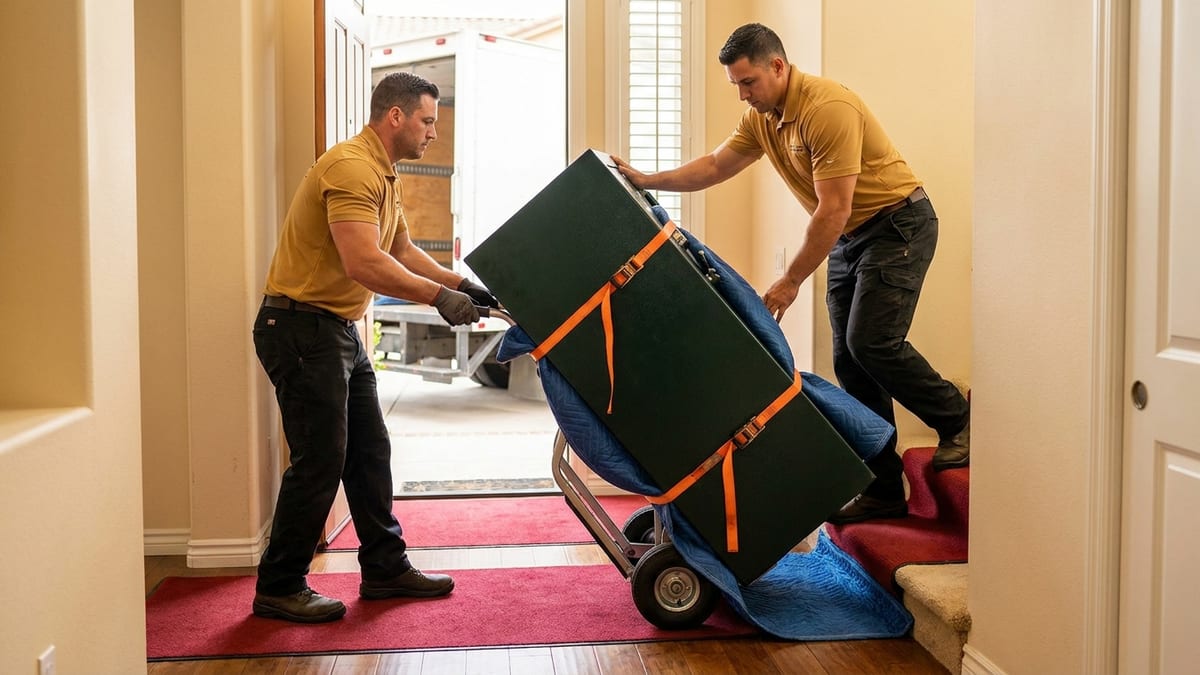
Gun safe moves in San Diego typically fall in the $400-$900 range as a market observation, with the mover’s written estimate driven by weight, stairs, and access. Stairs, narrow turns, and safes over 1,000 lbs push the number toward the high end. Qualified movers use the crew size, dollies, and floor protection needed for the job. Attempting it with two people and an appliance cart is how floors get gouged, doorframes get wrecked, and feet get crushed.
Why gun safes need a dedicated crew
A standard residential gun safe weighs between 300 and 800 lbs. Large rifle safes and commercial-grade vaults routinely hit 1,200 to 1,500 lbs or more. That’s not a job for a hand truck and two guys.
The weight alone isn’t even the hardest part. Gun safes are dense and low to the ground, with a center of gravity that shifts unpredictably when tilted. They’re also awkward to grip. Most have no built-in handles, so the crew is working with straps wrapped around a steel box that wants to fall forward.
Experienced movers typically assign a larger crew for heavy safes, often four people for loads above 600 lbs. Two guide and support from the front while two manage the dolly and control the descent or ascent. The crew communicates through every inch of the move.
This is the same reason licensed movers treat oversized safes the same way they treat a grand piano: the item has enough mass and awkwardness that shortcuts aren’t worth the risk to your property or the crew. The gun safe and piano movers page covers what that involves.
The equipment that makes it possible
Moving a gun safe without the right gear isn’t just hard. It’s dangerous.
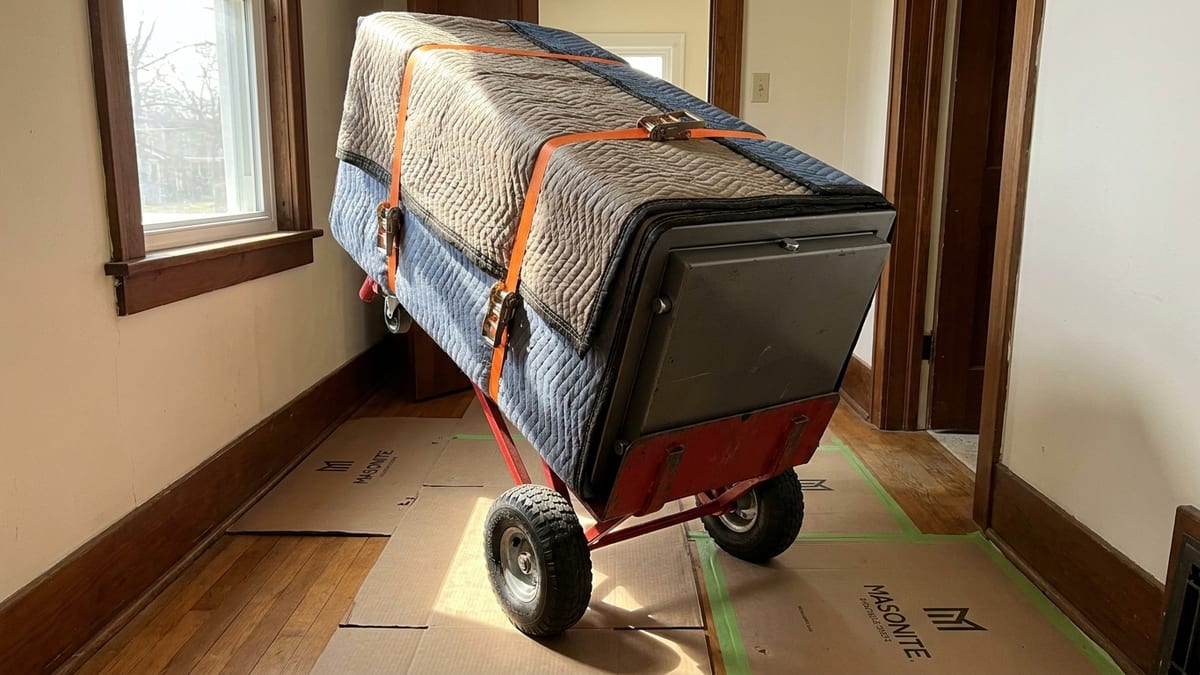
The core tools are a heavy-duty appliance dolly rated for the safe’s weight, a stair-climbing dolly for multi-story moves, thick moving blankets, ratchet straps, and floor protection. That last item gets skipped more than it should. Hardwood and tile floors in San Diego homes don’t stand a chance against the corner of a 600-lb safe being dragged even a few inches.
Floor protection means ram board or thick corrugated panels laid down before the dolly moves an inch. It also means felt pads on any surface the safe might contact along the route. When the move goes through a kitchen or living room, that protection matters even more.
For stairs, a stair-climbing dolly with rubber treads grips each step individually and keeps the weight from free-sliding. A standard appliance dolly on stairs with a 700-lb load is a recipe for losing control. The climbing dolly slows the whole thing down and gives the crew time to think through each step.
Beyond the tools, an experienced gun safe crew knows how to map the route before touching the safe. They’re looking at doorway widths, floor transitions, tight corners, and anything that could turn a straightforward move into a problem halfway through.
Why DIY gun safe moves go wrong
People underestimate the weight. That’s the short answer.
Most safes look like they might weigh 300 lbs. The actual number is often 500 to 700 lbs once the steel interior, door, and locking mechanism are accounted for. Add ammunition, firearms, and documents, and it climbs higher.
The second problem is that most people don’t have the right equipment. A furniture dolly from the hardware store isn’t rated for this kind of load, and it doesn’t have the grip or control a heavy appliance dolly provides. Trying to move a gun safe on an underpowered cart is how the cart fails mid-move and the safe tips.
The third issue is injuries. Back injuries and foot crush injuries are the two most common outcomes of DIY gun safe moves. A safe falling on a foot doesn’t just cause a fracture. It can cause serious long-term damage.
Beyond physical risk, floors and walls take the hit. Dragging a safe without proper protection leaves deep gouges in hardwood. A tipping safe can punch through drywall. Doorframes get cracked when the clearance is tighter than expected. Repair costs from a botched DIY move often exceed what professional movers would have charged.
For context, the same logic applies to large furniture: licensed movers use specific techniques for oversized and heavy pieces, which the furniture movers page covers. Gun safes just take that to another level.
Stairs and tight spaces in San Diego homes
San Diego’s housing stock includes a lot of older homes and multi-unit buildings that weren’t designed with large appliance moves in mind. Condos in Mission Valley, townhomes in North Park, and hillside homes in La Jolla present some of the trickiest gun safe move challenges in the county.
Narrow staircases are the most common obstacle. A wide safe going up a staircase with a landing turn takes careful planning and a stair-climbing dolly. The crew has to angle the safe through the turn without losing control on the slope.
Older craftsman homes in neighborhoods like Normal Heights and University Heights often have narrow doorways. A large safe may not fit through without removing the door first. An experienced crew measures the route before moving.
High-rise condos add the elevator variable. If the elevator is too small for the safe to stand upright, the team needs to tilt it, which changes the weight distribution and the required crew size. Some buildings also restrict elevator use to certain hours, which affects scheduling.
If your home has stairs or tight access, mention it when you call for a quote. It affects the crew size and time required, and it’s better to have that conversation upfront. Call (858) 400-4069 to discuss your specific setup with a licensed mover.
What drives the cost of moving a gun safe in San Diego
Several factors affect the final number.
Gun safe moves in San Diego fall in the $400-$900 range as a market observation tied to the mover’s written estimate. What pushes toward the high end:
- Safes over 600 lbs (a 4-person crew minimum)
- Stairs, tight turns, or narrow doorways
- Safes over 1,000 lbs
- Elevator buildings with oversized-safe logistics
- Additional distance across San Diego County
The actual figure depends on the specific weight and dimensions of your safe, the access at both locations, and any additional services like local movers bundled into the same job.
When you call, describe the safe accurately: weight, dimensions, model if you know it. That gives the mover the information needed to put a real number in writing.
California law and keeping contents secure
Firearms in California are subject to specific transport and storage requirements. When your safe is being moved, those rules still apply.
Leaving the safe locked throughout the move is the simplest approach. The contents stay secured, and there’s no question about access. If the safe must be emptied before the move due to weight or structural limits, firearms should be transported separately in compliance with California law.
This is not legal advice on California firearm transport. For questions about how to legally transport firearms during a move, check the California Department of Justice website or consult a licensed attorney familiar with California firearm law.
Keeping the safe locked and letting the crew focus on the safe itself is almost always the simplest and safest approach.
Frequently asked questions
How much does it cost to move a gun safe in San Diego?
Most gun safe moves in San Diego fall in the $400-$900 range as a market observation. Stairs, tight access, and heavier safes push the cost toward the high end. A safe over 1,000 lbs with two flights of stairs approaches the top of that range. Call (858) 400-4069 to be matched with a licensed mover who puts the actual figure in a written estimate.
How many movers does it take to move a gun safe?
Experienced movers typically assign at least 4 people for safes over 600 lbs. Lighter safes in the 300-500 lb range may be manageable with 3, but more people gives the crew better control for stairs, turns, and loading. Never attempt a DIY gun safe move with just 2 people.
Can gun safe movers handle stairs?
Yes. A trained crew uses a stair-climbing dolly, which grips each step and controls descent so the safe doesn’t free-slide. Stairs add time and cost, but they’re a routine part of San Diego gun safe moves given how many homes here are multi-story or hillside builds.
Should I empty my gun safe before the move?
It depends on the weight. Many residential safes can be moved locked and loaded. Very heavy safes, or safes in locations where every pound matters for floor load, may need to be partially emptied. Discuss this with your moving crew when you book. Regardless, firearms should be handled according to California law.
Can you move a gun safe through a narrow doorway?
Often yes, but it requires measuring first. Many standard doorways can pass a safe with careful angling. If the doorway is too narrow, the door may need to be removed or the safe tilted. An experienced mover assesses the route before moving anything.
Do gun safe movers also handle other heavy specialty items?
Yes. The same skills and equipment used for gun safes apply to pianos, large appliances, and oversized furniture. If you’re moving a piano at the same time, read the guide on how to move a piano without damaging it or your floors, and ask the mover about bundling both items into one job with local movers.